Tag: a hundred things

  • Royal Residences: Slottet – the Open Palace tour #22

    Just before I left Oslo, I took the guided tour of the Palace. It was the first day it was open this season – which kind of showed in some aspects. (A television set in the Council of State room hadn’t been turned on, and our guide didn’t quite know how to do it, for example.)

    I booked the ticket early, as soon as I noticed that it went on sale in March. (It seems to typically go on sale in the end of March/Beginning of April) The tour was in the end of June.

    You enter the palace from the back, where they had put up a tent for checking tickets.

    IMG_1858.JPG


    (more…)

  • Royal Residences: Oscarshall #21

    Royal Residences: Oscarshall #21

    20140731-200741-72461209.jpg
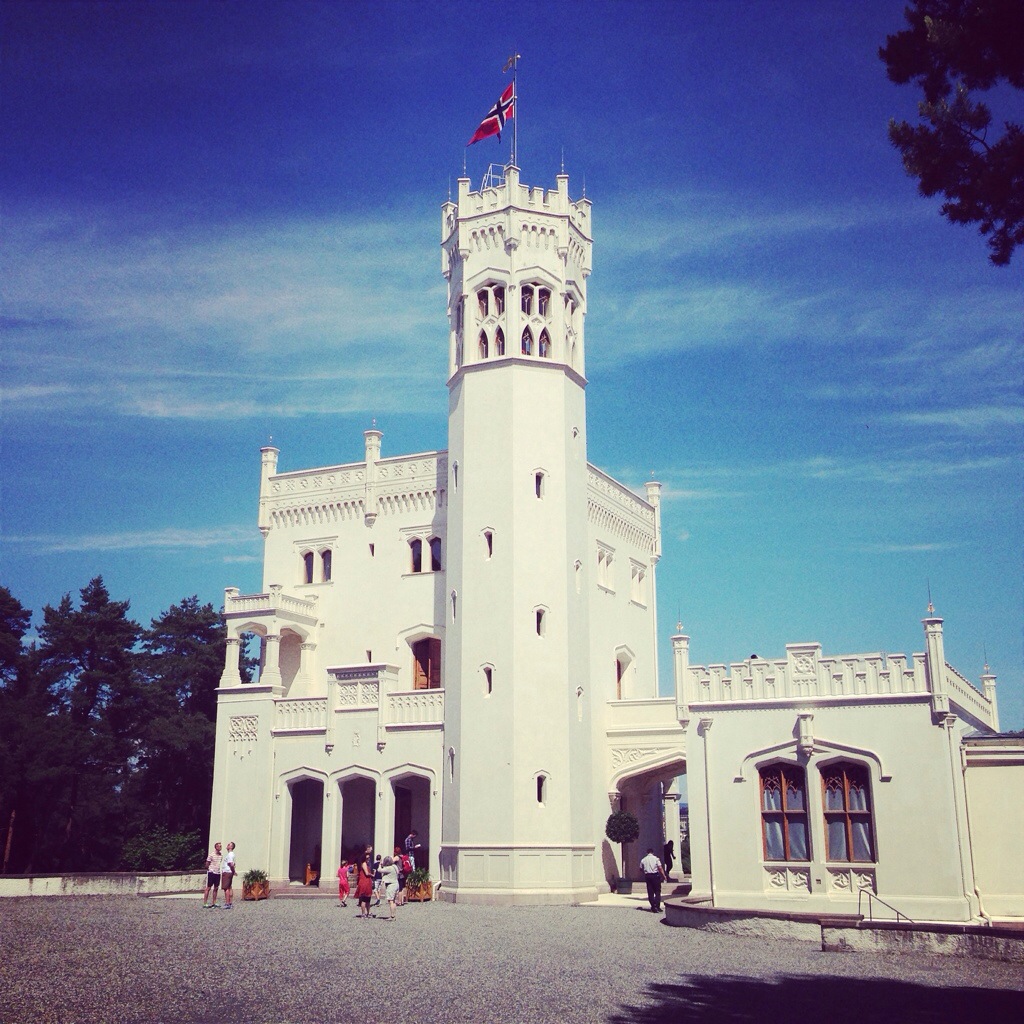
    A couple of weeks before I left Oslo, I took a trip to Bygdøy to visit Oscarhall. It is a pleasure palace built for King Oscar I of Sweden-Norway and his wife, Josephine of Leuchtenberg.

    It is still in use today by the royal family for special occasions, and Queen Sonja has set up an art gallery in one of the side buildings.

    The palace is beautiful on the outside, and the renovations inside have been done very nicely. The big surprise was the woodwork in the entrance hall that isn’t wood, but concrete painted to look like wood.

    (more…)

  • Norwegian royal family and their national costumes (#20)

    2014 is the bicentenary  of the Norwegian constitution. For a short period of time, in 1814, the Norwegian people chose to liberate themselves from foreign powers, elected a king, wrote a constitution, and then promptly were put in an union with Sweden. Until 1905. When we did it all again.

    Over the coming year, since it will be a celebration in Norwegian-ness, I thought it would be interesting to pinpoint the Norwegian royals and their national costumes. I will (try) to cover the costumes owned by the royals, one per post.

    From the time Queen Maud visited the country, while still being plain old Maud of Wales, and bought a national costume from Hardanger, to the costume worn by Princess Ingrid Alexandra. Five generations of  bunad-wearing Norwegian royals.


    (In Norwegian, the word for national costume is a bunad.)

    It feels rather appropriate, given that the promotion and reconstructions of the bunads  was one of the national-romantic methods for building a common, not-foreign, sense of nationality for the Norwegians that came out from the 19th century.

    I hope you will enjoy it.

  • The Danish painting (100 things #18)

    The big royal discussion of the past month ended up being the new painting of the Danish royal family done by painter Thomas Kluge. It can be viewed here.

    It has been likened to the poster for a horror film, such as The Omen, and Huffington Post compared the image of Prince Christian to one of the twins from the Shining. Isabella’s placement playing by herself in the front has also not been commented on favourably, in some cases people say she looked like she was possessed. Ekstrabladet gathered some of the comments from Danish people and art critics, and one of them compared the royal family to looking like the Addams Family.

    The painting was supposed to be the modern day replacement of the big family portrait from the 1880s by Tuxen. You can see the same image in the background on the older version as the newer version, which (I suppose) ties them together in a way. The problem with the comparison between the two images is that in the older version, though you have groups here and there, and they very well could have been sitting for the portrait in different times and been painted together, it still looks like they are in the same room at the same time and one somewhat cohesive family.

    Technically, Kluge is a very good painter, but the use of lighting and placement of the people gives the image a dark and photoshopped feel that a family portrait, even a royal one, shouldn’t have had to have. He has been critiqued before, for the portrait he did of Queen Margrethe in 2000. In said portrait she ended up looking more distant and colder, than she is. (Incidentally, he also did one in 1996 of her, where she was bathed in light and looked rather warm and approachable.)

    It should definitely have been possible to gather the family under one roof for the time it would take to pose them more naturally and have them in one place for the inspiration. When Kluge started the work with the painting in 2011, they were 11 people in the family. Then the twins and Athena came along, which must have upset the posing somewhat. But not to the degree it has ended up looking so photoshopped.

    I feel that a lot could be rectified if they had just been in the same room together while posing.

    Maybe then, Isabella wouldn’t be playing on her own on one of the sides and could have joined her cousins?


  • King Christian X and the jews (A 100 things #17)

    During the German occupation of Denmark, Christian X kept up with his morning rides through Copenhagen. In 1943, the Independent Jewish Press Services, that the King, after hearing the news of the new Nazi laws to identify Jews in Denmark by the armband said: “When that happens, I will myself wear the yellow star on my uniform, and I will order my staff to follow my example.”

    From this, the lore that he wore the yellow starred armband on his rides arose.

    But research from 2001 showed that the Independent Jewish Press Services, Inc got it from The Jewish Telegraphic Agency in London who had a story in 1942.   allegedly got the “news” from either Danes in exile or  The National America Denmark Association , who wanted to improve Denmark’s reputation abroad after the weak fight against the German invasion – and it was fiction.

    And the myth ended up living for a long time.

    The truth ended up being that a large majority of the Danish Jews ended up escaping to Sweden in 1943, and survived the war thusly.

    There is an examination of history by the Danish-Israeli doctor and historian, Dan Kaznelson, that describes this escape, and the part the Danish health service did to aid this escape. The hospital in Bispebjerg in Copenhagen was the coordinating force with a young doctor called Køster being the driving force.

    Since there were so many Jews and so little time, there was a lack of funds to give to the fishermen (who would get the Jews over the Øresund strait to Sweden) and taxi-drivers (who would get them to the boats.) The ambulances from the hospital were not enough.

    Køster then sent two nurses to Sorgenfri Palace where King Christian was in house-arrest. His health was not good, so two nurses would not arise suspicion. The nurses were sent to ask the King personally for funding. Køster’s written report was that “the nurses did not leave the palace disappointed,” leading Kaznelson to (according to Berlingske) conclude that the King did supply funds for the transport of Danish Jews to Sweden.

  • The succession to the Belgian throne (A 100 things #16)

    Now that we’ve had a Belgian abdication, and a new King of the Belgians, it is time to look at the Belgian line of succession.

    Unlike in the Netherlands, the line of succession does not change overly much when the monarch ascends to the throne – everybody else just takes one jump ahead in the line at the same time.

    The Belgian throne goes through the male-line descendant from Leopold I until Albert II, with those that have asked permission from the monarch for their marriage. Since women were also included in the line from 1991 when Belgium abolished the Salic law in the succession, it was mentioned that the King had given permission for Princess Astrid and Prince Lorenz to marry, and Princess Astrid and her descendants jumped in between Prince Philippe and Prince Laurent in the line.

    (There are voices that say that it was done in this way as King Baudouin did not want Prince Laurent to be as close to the throne as he was before 1991.)

    To avoid all the offspring of the daughters of Belgian kings also inheriting the rights to the throne suddenly, it was added a codicil that the change first went in effect with Prince Astrid and her offspring. By the time the change came about, Princess Astrid and Princess Marie-Laura were the two first women with rights to the Belgian throne. When Princess Maria Louisa was born in 1995, she was the first Belgian princess who was born with rights to the Belgian throne.

    After 1991, women have equal rights as men to the throne,  and since last Sunday, 12 year old Princess Elisabeth has held the title the Duchess of Brabant and is the first in line.

    Should the King die while she is still under the age of 18, and a minor, the Belgian government will approve a regent. (Although, for the Belgian government to agree on anything can take time, as we’ve seen in the past, so Elisabeth could well reach the age of 18 before that happens.)

    (more…)

  • The six previous kings of Belgium (100 things #15)

    The Belgian people gets its seventh king today. Because I like trivia –  quick biographies about the six previous ones

    (more…)

  • Magasinet’s recent interview with Mette-Marit – a summary in English (100 things #14)

    Before Princess Madeleine’s wedding, Crown Princess Mette-Marit stopped up in Burma on the way home from the Women deliver conference in Malaysia. She travelled around visiting humanitarian projects both with PSI, the Norwegian Red Cross and the Norwegian People’s Aid. Magasinet, the Saturday magazine that comes with Dagbladet, was invited to join in her trip and interview her. The interview is available in a paid Norwegian version online, but I’ve bought the paper version and is using that as my basis for the following English summary and translation.

    (more…)

  • Abdication in Belgium (100 things #13)

    Yesterday, King Albert II of the Belgians announced that he is abdicating. You can watch his speech in French in the YouTube video below. I’ve also been pondering a bit about this – I’m by no means a Belgium expert or follow the Belgian royals avidly, so feel free to chime in if you want.

    2013 is really turning into the year of abdications, isn’t it? First the Netherlands, then the Emir of Qatar announces that he will be abdicating, and now the King of the Belgians follow suit.

    (more…)